How to Advertise on Blinkit, Zepto & Instamart in India
Ammar
AI Specialist
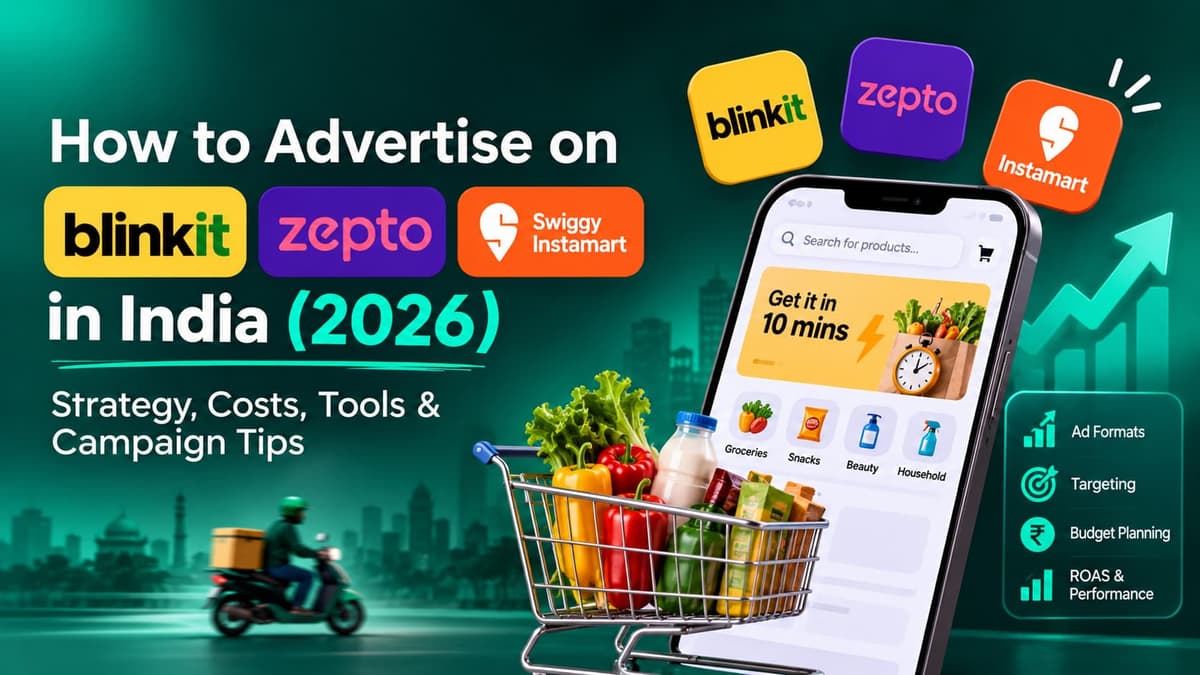
Quick commerce is changing how Indian consumers discover and purchase everyday products. Platforms such as Blinkit, Zepto and Swiggy Instamart are no longer just delivery channels; they are becoming important advertising destinations for FMCG, beauty, personal care, food and D2C brands. Businesses can now reach shoppers while they are actively searching for products and making purchase decisions. But running profitable campaigns requires more than simply purchasing sponsored placements. Brands need the right product listings, inventory availability, platform selection, advertising strategy and measurement framework. This guide explains how to advertise on India's leading quick-commerce platforms in 2026 and how to evaluate whether the investment is generating profitable sales.
What Is Quick Commerce Advertising?
Quick commerce advertising is paid product promotion within apps that offer rapid delivery of everyday products. In India, the major platforms include Blinkit, Zepto and Swiggy Instamart. Unlike traditional social media advertising, where brands interrupt users while they browse content, quick-commerce advertising reaches customers when they are already shopping. For example:
• A customer searches for protein bars and sees a sponsored product.
• Someone browsing personal care products discovers a new skincare brand.
• A shopper sees a promotional placement while exploring a grocery category.
This makes quick-commerce advertising particularly relevant for brands selling products that customers purchase frequently or need immediately.
1. Why Are Indian Brands Investing in Quick Commerce Advertising?
Quick commerce is creating a new retail media opportunity for Indian businesses. According to a Mint report published in August 2026, commerce-led advertising is becoming an important part of India's advertising market, with brands shifting budgets towards platforms such as Blinkit, Zepto and Swiggy Instamart. There are several reasons behind this shift. High purchase intent: Customers are already searching for products instead of simply consuming entertainment content. Product discovery: Sponsored placements help products become visible in competitive categories. Faster purchase journeys: Customers can discover a product and complete a purchase within the same app. Location-based opportunities: Brands can focus on specific cities and locations where their products are available. Retail media measurement: Advertising dashboards can provide campaign-level information such as impressions, clicks and attributed sales, depending on the platform. However, advertising does not guarantee sales. Product availability, pricing, reviews, competition and conversion rates still matter.
2. Blinkit vs Zepto vs Swiggy Instamart: Which Platform Should You Choose?
Each platform offers advertising opportunities, but the available campaign formats, access processes and reporting capabilities differ.
| Comparison | Blinkit | Zepto | Swiggy Instamart |
|---|---|---|---|
| Advertising access | Brand Central | Brand partner portal | Partner and advertising teams |
| Sponsored placements | Yes | Yes | Yes |
| Search advertising | Yes | Yes | Available formats vary |
| Banner advertising | Yes | Yes | Yes |
| Brand pages | Yes | Available formats vary | Available formats vary |
| Campaign reporting | Brand Central | Brand portal | Depends on campaign access |
| Best starting point | Product discovery | Product discovery | Category and audience fit |
Blinkit: Blinkit offers Brand Central, its advertising platform for brands. Advertisers can use sponsored placements across search, categories, recommendations and brand stores. Official platform: https://brands.blinkit.com/
Zepto: Zepto provides a brand partnership portal with advertising opportunities to improve product visibility and brand discovery. Official platform: https://brands.zepto.co.in/
Swiggy Instamart: Brands can explore advertising opportunities through Swiggy's Instamart partner ecosystem and advertising teams. Partner portal: https://partner.instamart.in/
The right platform depends on your category, target locations, customer demand, product availability and commercial terms. Do not assume one platform will perform equally well for every brand.
3. Types of Quick Commerce Ads Available in India
Understanding the available ad formats helps businesses select campaigns according to their objectives.
1. Sponsored Product Ads
Sponsored products appear in search results or category listings. Best suited for:
• Brands targeting high-intent searches.
• Products competing against similar alternatives.
• Businesses looking to improve product discovery.
3. Category Advertising
Category placements help brands reach shoppers exploring a specific product category. For example, a personal care brand may want visibility when users browse skincare or haircare products.
4. Recommendation Ads
Recommendation placements help products appear in relevant browsing or shopping contexts. These can support product discovery and cross-selling, depending on the platform's available inventory.
5. Brand Store Placements
Brand stores provide a dedicated destination where shoppers can explore a brand's available products. These are particularly useful for brands with multiple SKUs and a broader product range. Remember that format names, availability and buying models can change. Confirm the latest inventory with each platform before committing campaign budgets.
4. How to Start Advertising on Blinkit, Zepto and Instamart
Before investing in advertising, businesses should prepare their product catalogue and commercial information.
Step 1: Get Your Products Listed
Your products need to be available on the relevant platform before you can meaningfully promote them. Prepare:
• Product names and descriptions.
• Product images.
• SKU information.
• MRP and selling prices.
• Product category.
• Available inventory.
Step 2: Complete Brand Onboarding
Contact the relevant platform or use its official brand portal. Confirm:
• Advertising account eligibility.
• Brand verification requirements.
• Available campaign formats.
• Commercial terms.
• Reporting access.
Step 3: Select Your Campaign Objective
Decide what you want to achieve.
| Objective | Suitable Advertising Approach |
|---|---|
| Product discovery | Sponsored product placements |
| New product launch | Banners and product promotion |
| Category visibility | Category placements |
| Improve product sales | Search and recommendation ads |
| Brand awareness | Homepage and display placements |
Step 4: Choose Target Locations
Do not advertise everywhere simply because your brand operates nationally. Start with cities and serviceable areas where:
• Your products are available.
• Inventory is sufficient.
• Demand already exists.
• Your margins support advertising expenditure.
Step 5: Launch a Controlled Test
Start with a limited set of SKUs and locations. Track performance before increasing campaign expenditure.
5. How Much Budget Should You Allocate to Quick Commerce Ads?
One of the biggest questions for brands is how much they should spend on Blinkit, Zepto or Instamart advertising. There is no universal advertising budget because pricing depends on the platform, category, city, placement, competition and campaign terms. Quick-commerce platforms do not provide one universal public rate card covering every advertising format. Your budget should account for:
• Sponsored product advertising.
• Banner and category placements.
• Creative production.
• Platform and operational costs.
• Product margins.
• Inventory and fulfilment requirements.
Example: Planning a Quick Commerce Advertising Budget
Consider a hypothetical D2C brand with three products.
| Budget Component | Monthly Allocation |
|---|---|
| Sponsored product campaigns | ₹40,000 |
| Promotional placements | ₹20,000 |
| Creative testing | ₹10,000 |
| Total planned budget | ₹70,000 |
This is an illustrative planning example, not a platform minimum or quoted market rate. The actual allocation should depend on the available inventory, campaign quotations and expected contribution margin.
6. How to Measure ROAS and Profitability
A campaign generating high sales is not necessarily a profitable campaign. For example, suppose a brand spends ₹50,000 on advertising and receives ₹2,00,000 in attributed sales. Its platform ROAS is: ROAS = Advertising-attributed revenue ÷ Advertising spend ROAS = ₹2,00,000 ÷ ₹50,000 = 4x However, this calculation does not include product costs, platform commissions, discounts, fulfilment expenses or other operating costs. A better way to evaluate the campaign is to calculate contribution after all relevant variable costs.
Important metrics to monitor:
| Metric | What It Tells You |
|---|---|
| Impressions | How often your products appear |
| Clicks | How many shoppers interact with your ads |
| CTR | How effectively your placement attracts attention |
| CPC | Cost per click |
| Conversion Rate | Percentage of clicks resulting in purchases |
| ROAS | Attributed revenue compared with ad spend |
| Contribution Margin | Revenue remaining after relevant variable costs |
| Organic Sales | Sales without paid advertising attribution |
Do not rely on platform ROAS alone. Compare advertising-attributed revenue with actual commercial profitability.
7. Why Quick Commerce Advertising Campaigns Fail
Even with advertising budgets, brands can struggle to achieve profitable results. Here are some common reasons.
Advertising Out-of-Stock Products
If your product is unavailable in the locations being targeted, advertising may generate wasted impressions or clicks. Check inventory before and during campaigns.
Poor Product Images
Customers make decisions quickly on small screens. Use clear product images that communicate the product, packaging and important differentiators.
Incorrect Pricing Strategy
A product that is significantly more expensive than competing alternatives may struggle to convert. Evaluate pricing, offers and pack sizes.
Ignoring Product Ratings and Reviews
Customer feedback can influence purchase confidence. Monitor reviews and address recurring product or fulfilment complaints.
Scaling Too Quickly
Increasing campaign expenditure before understanding profitability can lead to unnecessary losses. Test first, optimize second and scale only when the economics support it.
8. Quick Commerce vs Amazon Ads vs Meta Ads
Brands should understand that these channels serve different purposes.
| Factor | Quick Commerce Ads | Amazon Ads | Meta Ads |
|---|---|---|---|
| Customer mindset | Immediate shopping | Product research and shopping | Discovery and consideration |
| Purchase intent | Often high | Often high | Varies |
| Main advertising formats | Sponsored listings and banners | Sponsored Products and display | Feed, Stories and Reels |
| Main objective | In-app product discovery | Marketplace sales | Awareness, traffic and conversions |
| Inventory dependency | Local platform availability | Marketplace stock | Depends on fulfilment capability |
| Measurement | Platform-attributed sales | Marketplace-attributed sales | Pixel, CAPI and attribution |
The best channel depends on your product, audience, margins and distribution strategy. For some brands, the right approach is to combine quick-commerce advertising with marketplace advertising and social media campaigns.
9. How to Build a Profitable Quick Commerce Advertising Strategy
A sustainable strategy requires coordination between advertising, creative, inventory and commercial teams. Follow this framework. Start with the right products: Prioritize SKUs with healthy margins, competitive pricing and sufficient stock. Choose the right locations: Focus on areas where customers can actually purchase your products. Build platform-specific creatives: Adapt product images and promotional messages to each platform's available placements. Monitor campaigns regularly: Review SKU-level performance, clicks, conversions and stock availability. Calculate real profitability: Account for advertising, product and operational costs. Scale based on evidence: Increase spending on products and locations that demonstrate sustainable contribution. For a more detailed creative approach, read our guide on Quick Commerce: New Rules of Creative Advertising.
10. How Garage Collective Helps Brands Grow Through Performance Marketing
Quick commerce advertising should not operate independently from a brand's wider marketing strategy.
At Garage Collective, performance marketing connects campaign planning, creative strategy, media buying, analytics and conversion optimization.
At Garage Collective, performance marketing connects campaign planning, creative strategy, media buying, analytics and conversion optimization.
• Which advertising channels deserve investment.
• Which products should receive promotional support.
• How creative assets influence customer decisions.
• Whether campaigns generate profitable business outcomes.
• How to improve measurement across platforms.
Explore our Performance Marketing Services to understand how a connected advertising strategy can support business growth.
Frequently Asked Questions
1. How do I advertise on Blinkit in India?
Brands can explore Blinkit's Brand Central platform at brands.blinkit.com. Advertising opportunities include sponsored placements, product promotion and other in-app formats, subject to account eligibility and availability.
2. Can D2C brands advertise on Zepto?
Yes. Brands selling on Zepto can explore advertising opportunities through its official brand portal. Available formats and commercial terms should be confirmed with the platform.
3. How much does Blinkit advertising cost?
Blinkit does not provide one universal public rate card for every advertising placement. Costs depend on campaign format, bidding, targeting and commercial terms.
4. Which is better for advertising: Blinkit, Zepto or Instamart?
There is no universally best platform. Compare product availability, category demand, audience, campaign formats, reporting and profitability before choosing.
5. Is quick commerce advertising suitable for small D2C brands?
It can be suitable for smaller brands with platform distribution, sufficient inventory, competitive pricing and healthy product margins. Start with controlled campaigns.
6. What is a good ROAS for quick commerce advertising?
There is no single ROAS benchmark that guarantees profitability. Calculate your break-even ROAS using product margins, platform costs, fulfilment and advertising expenses.
7. What products work best on quick commerce platforms?
Frequently purchased products such as food, beverages, personal care, household essentials and selected wellness products can be suitable. Actual performance depends on category demand and distribution.
8. Can quick commerce ads increase brand awareness?
Yes. Sponsored listings, banners, category placements and brand stores can increase product visibility. Awareness should be measured separately from sales conversions.
Conclusion
Quick commerce is creating new advertising opportunities for Indian D2C, FMCG and consumer brands. Blinkit, Zepto and Swiggy Instamart offer different ways to connect with customers during their shopping journey. However, choosing the right platform is only the first step. Successful campaigns require strong product listings, competitive pricing, consistent inventory, relevant creatives and reliable performance measurement. The objective should not simply be to generate more clicks or higher platform-reported ROAS. It should be to build campaigns that produce measurable and profitable business growth.
Like what you're reading?
Get a free marketing plan tailored to your brand
Get Your Free Planyes, actually free. we're not kidding.
Key Takeaways
- Quick commerce advertising helps brands reach customers during active shopping journeys.
- Blinkit, Zepto and Instamart offer different advertising formats and opportunities.
- Product availability, pricing and margins are essential before launching campaigns.
- Platform-reported ROAS should always be compared with actual profitability.
- Start with controlled campaigns, optimize SKU-level performance and scale based on results.
the TL;DR your boss will love
This Isn't Just Theory. We Do This Daily.
Let us show you exactly what we'd do for your brand - strategy, channels, budget, timeline. Free. No pitch deck.
Get Smarter Every Week
Ideas, data, and the occasional hot take. Biweekly, no spam.
we promise not to sell your email to robots
You Might Also Dig These
^ we picked these just for you (okay, the algorithm did)
Google's October 2026 AI Content Guidance: SEO and E-E-A-T Checklist
Google updated its guidance on generative AI content on 1 October 2026, aligning the documentation more closely with its Search Quality Rater Guidelines. The update does not create a special ranking system for AI-written pages. It sharpens the standard that matters: content should serve a clear audience, demonstrate real expertise and make factual claims easy to verify. For Indian marketing teams using AI at scale, the operational question is no longer whether AI may be used. It is whether every published page adds original value, accountable authorship and dependable evidence.
ReadIndia Festive Commerce Playbook 2026: D2C, Quick Commerce and Always-On Growth
India’s festive season remains a major commercial opportunity, but e-commerce demand is no longer limited to a few sale events. NIQ describes a market shaped by both habitual purchases and event-driven peaks, while Meta points to video-first discovery, creators and messaging-led commerce. A useful festive plan connects demand forecasting, channel roles, creative and customer experience from discovery through repeat purchase.
ReadUltimate Guide to AI-First Agency Month: Optimize Performance Marketing ROI Amid Rising Ad Costs in India
Struggling to keep up with rising ad costs and ever-changing Google and Meta algorithms? Indian marketers, startups, and D2C brands are feeling the pressure to scale smarter - not harder. Ready to cut through the noise and supercharge your performance marketing ROI? This guide reveals AI-first strategies, proprietary tools, and proven tactics to help you stay ahead and win big in India’s digital market.
Read